

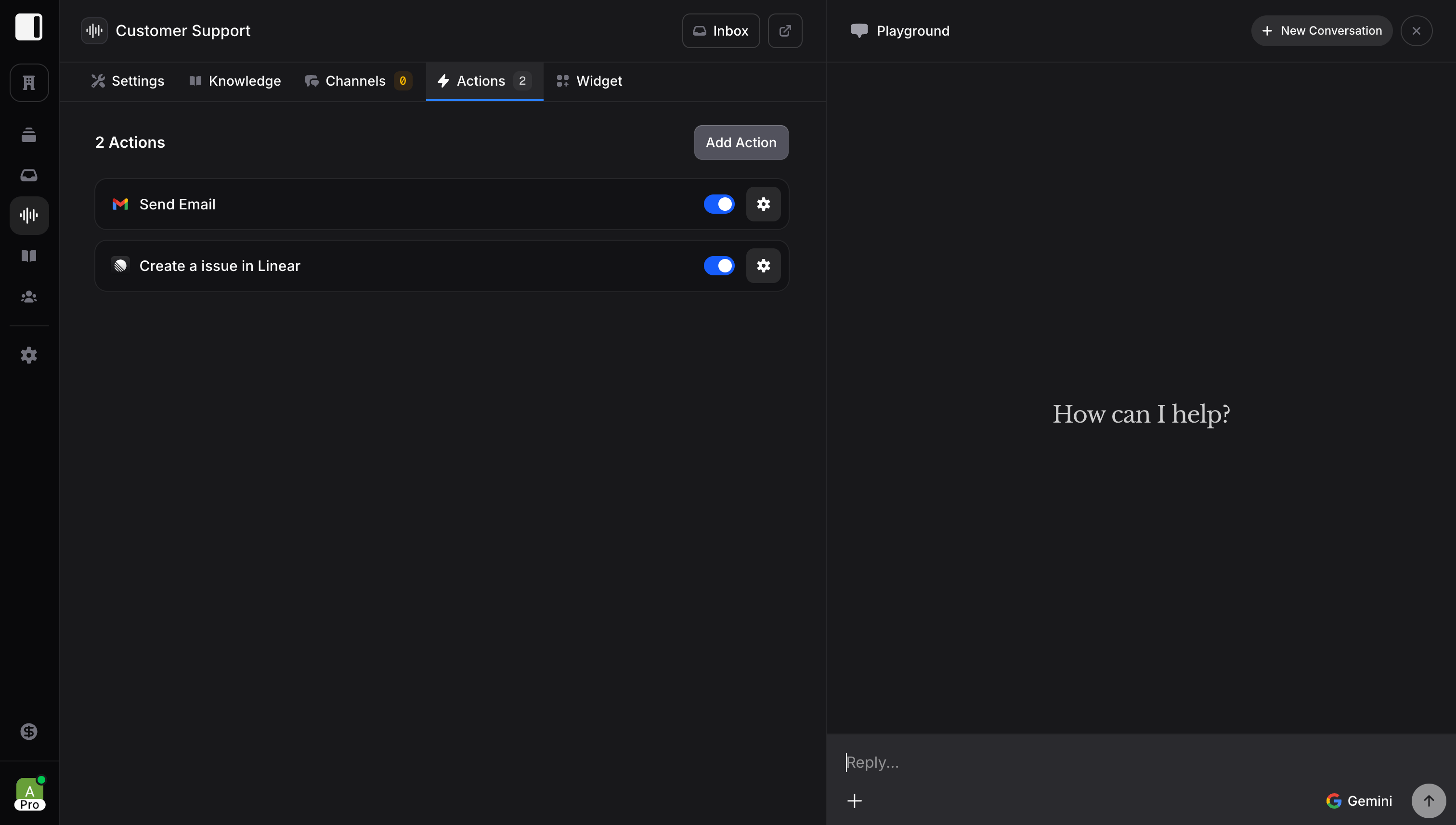
What Are Actions?
Actions are integrations that let your assistant interact with external services. Instead of just saying “I can help you book an appointment,” your assistant actually books it. Without actions: “Please visit our website to book an appointment.” With actions: “I’ve booked you for Tuesday at 2 PM. You’ll receive a calendar invite shortly.”Adding Actions
- Go to your assistant’s Actions tab
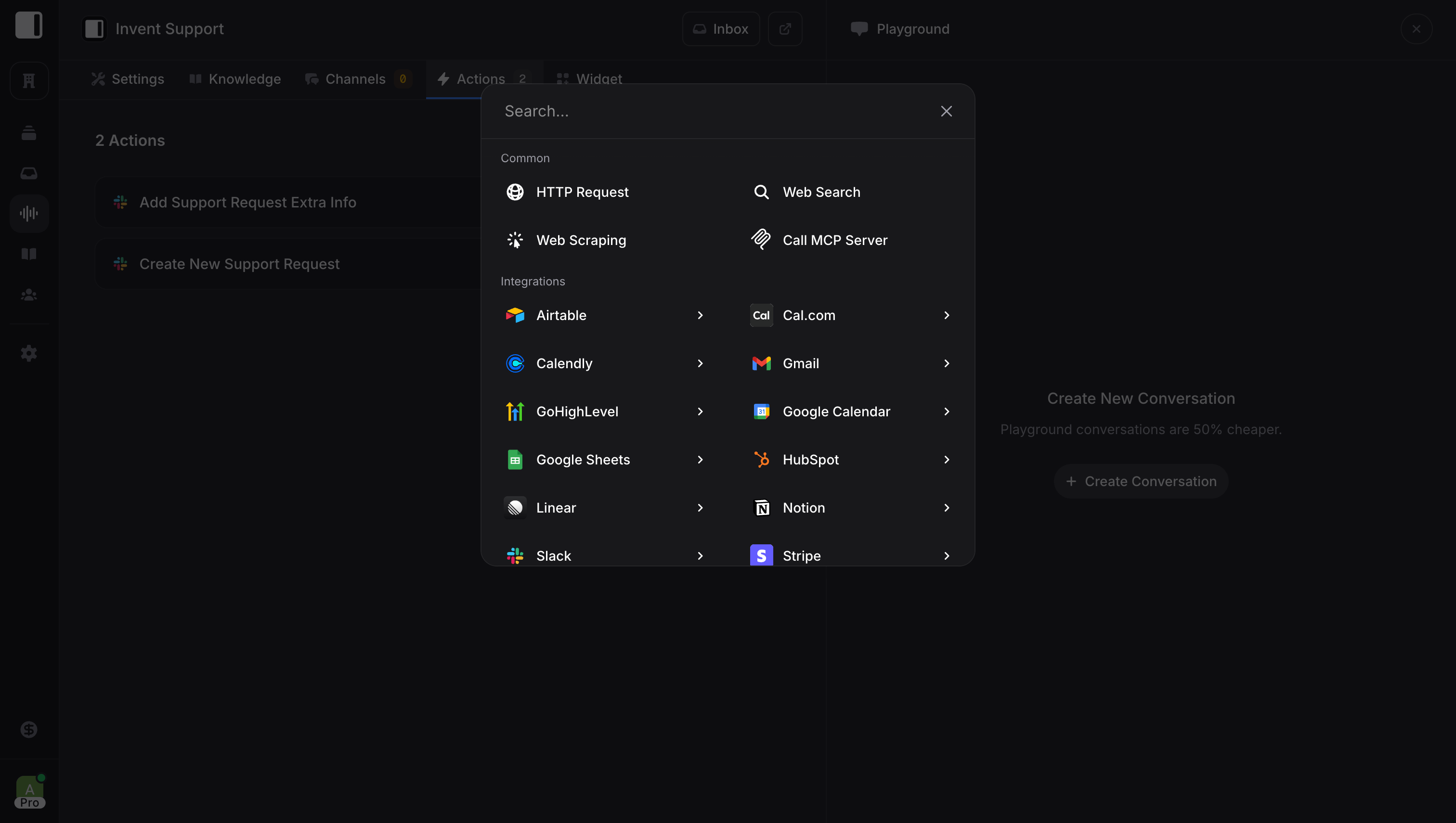
- Click Add Action
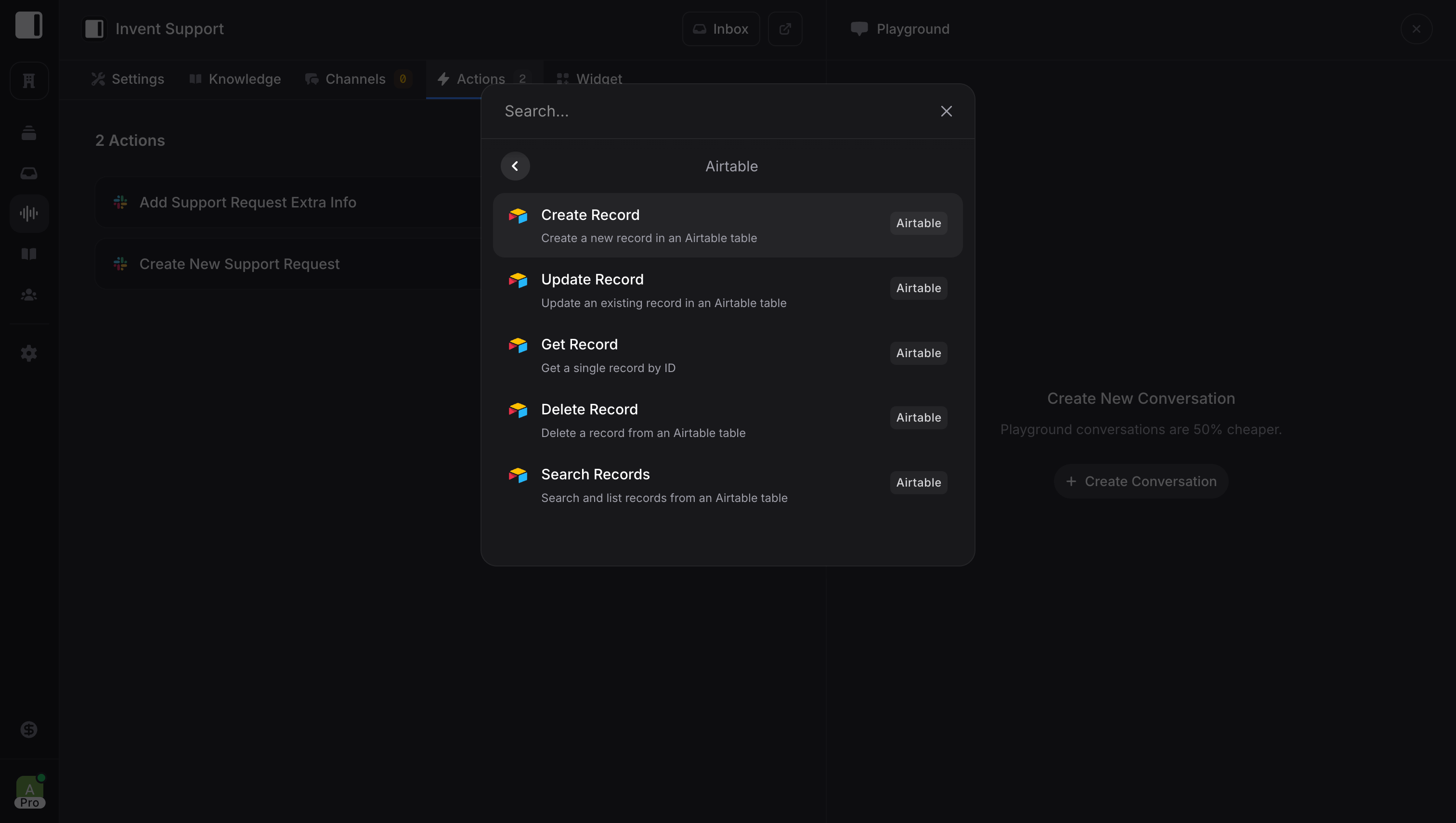
- Choose an integration (like Google Calendar)
- Select the specific action (like Create Event)
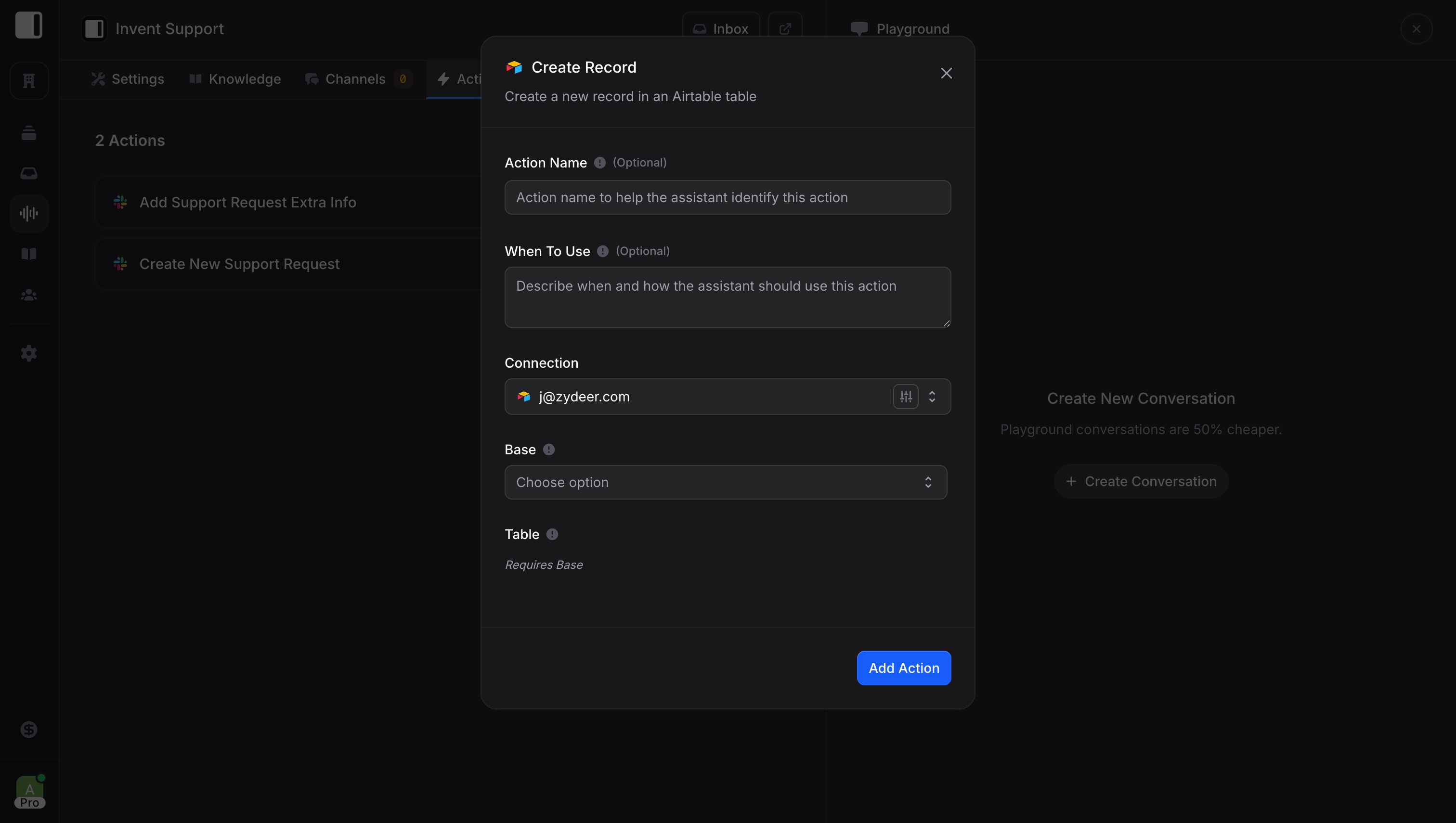
- Configure the action settings
- Click Add Action
Available Integrations
Invent integrates with popular services across multiple categories:- Scheduling: Book and manage appointments with calendar services like Google Calendar, Cal.com, and Calendly
- Communication: Send messages via email, Slack, SMS, and other communication platforms
- CRM & Sales: Connect to your CRM to manage contacts, leads, deals, and customer relationships
- Productivity: Work with spreadsheets, project management tools, note-taking apps, and task managers
- Payments: Process payments and create checkout links through payment processors
- E-commerce: Access order information, product catalogs, and customer data from your store
- Utilities: Search the web, scrape data from websites, call any API endpoint, or trigger custom workflows
AI Controlled Fields
This is where the magic happens. When configuring an action, most fields are set to AI Controlled by default.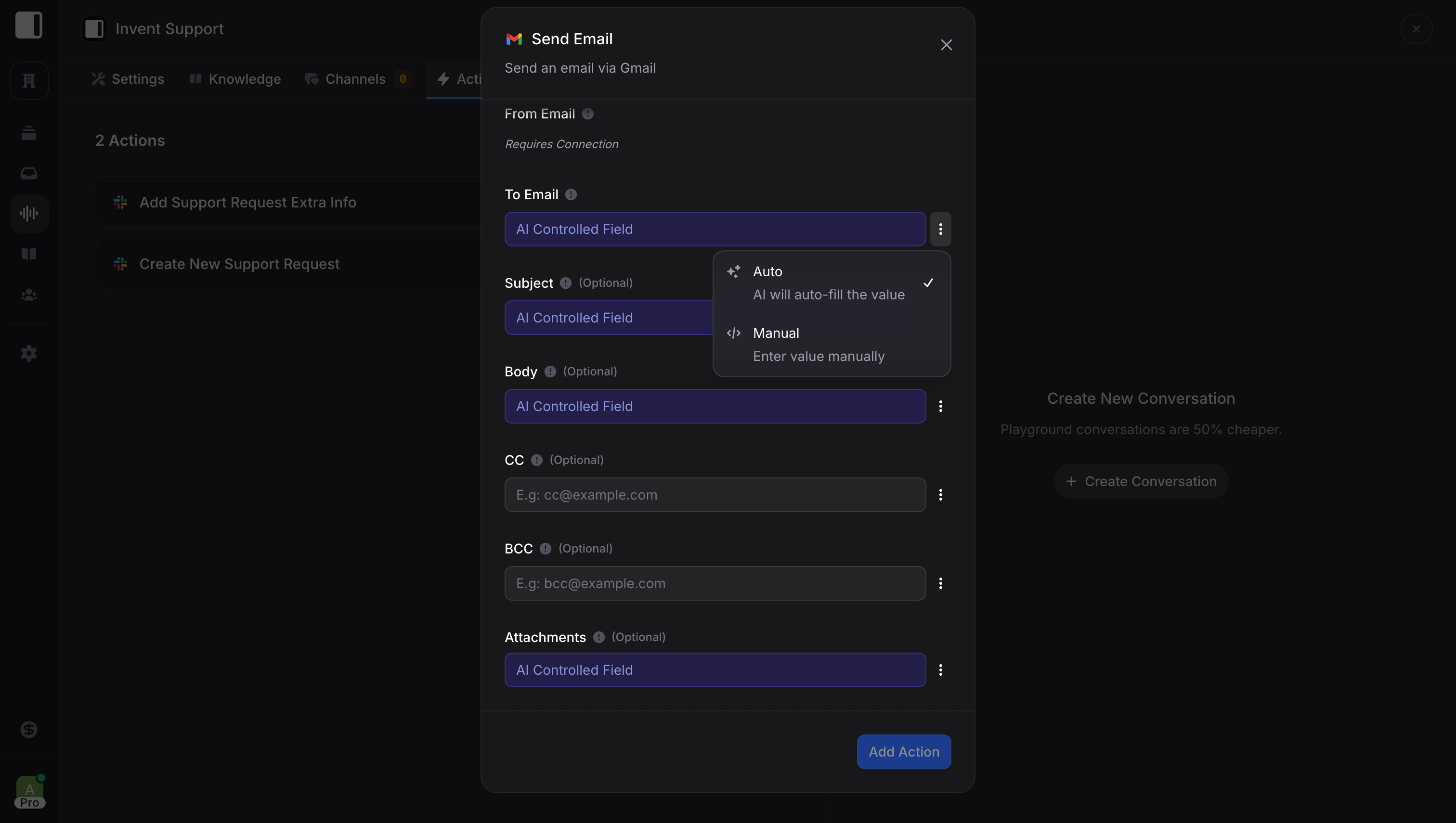
What Does AI Controlled Mean?
Instead of you hardcoding values, your assistant figures them out from the conversation. Example: Creating a Calendar Event| Field | AI Controlled Behavior |
|---|---|
| Event Title | AI extracts from conversation (“Yoga class with Maria”) |
| Start Date | AI understands “next Tuesday at 2 PM” |
| Description | AI summarizes what was discussed |
| Attendee Email | AI asks if not provided |
When to Override AI Control
Sometimes you want specific values regardless of conversation:- Calendar ID: Always use your business calendar
- Default duration: All appointments are 1 hour
- Notification settings: Always send email reminders
Action Configuration
Each action has:Action Name (Optional)
A custom name to help your assistant identify this action. Useful when you have multiple similar actions.When To Use (Optional)
Guidance for your assistant on when to trigger this action. For example:“Use this action when a customer wants to book an appointment and has provided their preferred date and time.”
Connection
Which account to use. For Google Calendar, this is which Google account’s calendar to access. You can connect multiple accounts and choose the right one for each action.Action-Specific Fields
Each action has different fields. For Google Calendar’s Create Event:- Calendar: Which calendar to add the event to
- Event Title: Name of the event
- Description: Event details
- Start Date: When it starts
- End Date: When it ends
- Attendees: Who to invite
- Visibility: Public or private
- Reminders: Notification settings
Enabling and Disabling Actions
Each action has a toggle to enable or disable it. Disabled actions won’t be used by your assistant, but the configuration is preserved. This is useful for:- Testing new actions before going live
- Temporarily disabling actions during maintenance
- A/B testing different action configurations
Multiple Actions
Your assistant can have many actions. During a conversation, it automatically chooses the right one based on context. Customer: “I need to book an appointment for next week” → Assistant uses Create Event action Customer: “Can you check if I have anything scheduled tomorrow?” → Assistant uses Search Events action Customer: “Actually, can we move it to Thursday?” → Assistant uses Update Event actionBest Practices
- Start simple: Add one action, test it thoroughly, then add more
- Use descriptive names: “Book Yoga Class” is better than “Create Event”
- Write clear “When To Use” instructions: Help your assistant know when to trigger each action
- Test in the Playground: Verify actions work before customers use them
- Monitor action usage: Check that actions are triggering correctly
Troubleshooting
Action Not Triggering
- Check that the action is enabled (toggle is on)
- Verify the “When To Use” instructions are clear
- Test in the Playground with explicit requests
Wrong Values Being Used
- Review which fields are AI Controlled vs fixed
- Add more specific “When To Use” instructions
- Consider overriding AI Control for problematic fields
Connection Errors
- Reconnect the integration
- Verify the connected account has necessary permissions
- Check if the external service is experiencing issues